

Known by seven in ten: measuring what Vaibhav Sooryavanshi is already worth
Joseph Eapen, Head of India & Subcontinent at GSIQ, on what 3,800 interviews across ten IPL markets say about the commercial value of one teenager.
Fan & Sponsor Impact Study, July 2026:
n = 3,800 across ten IPL franchise markets
If you were to take a look at the Indian polling on the IPL’s most familiar players right now, you would find the usual names – but one that is new. Fourth on the list sits a player just two IPL seasons into his career: Vaibhav Sooryavanshi. He has an aided recognition rate of 70% among the Indian public.
Sooryavanshi is no longer being measured against the players coming through. He is being measured against India’s established order.
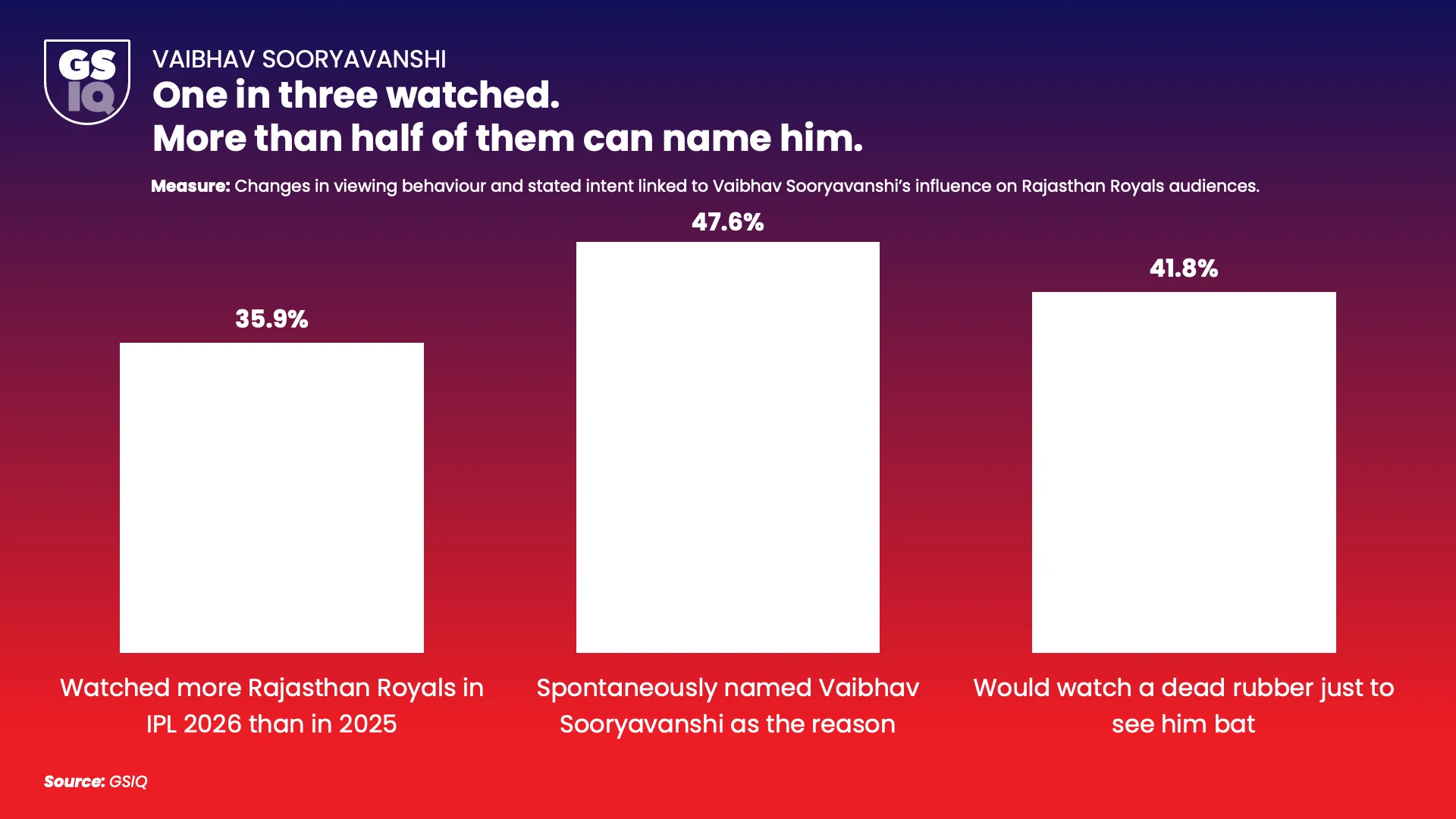
In July we ran 3,800 interviews across all ten IPL franchise markets — 380 in each, ages 15 to 55, NCCS A, B and C — to test what that recognition is actually doing. Four in ten of the sample (41%) qualify as exposed: they watched five or more Rajasthan Royals matches this season, or they follow him. The remaining 59% form a lighter-exposure control, and that is the comparison base for everything below.
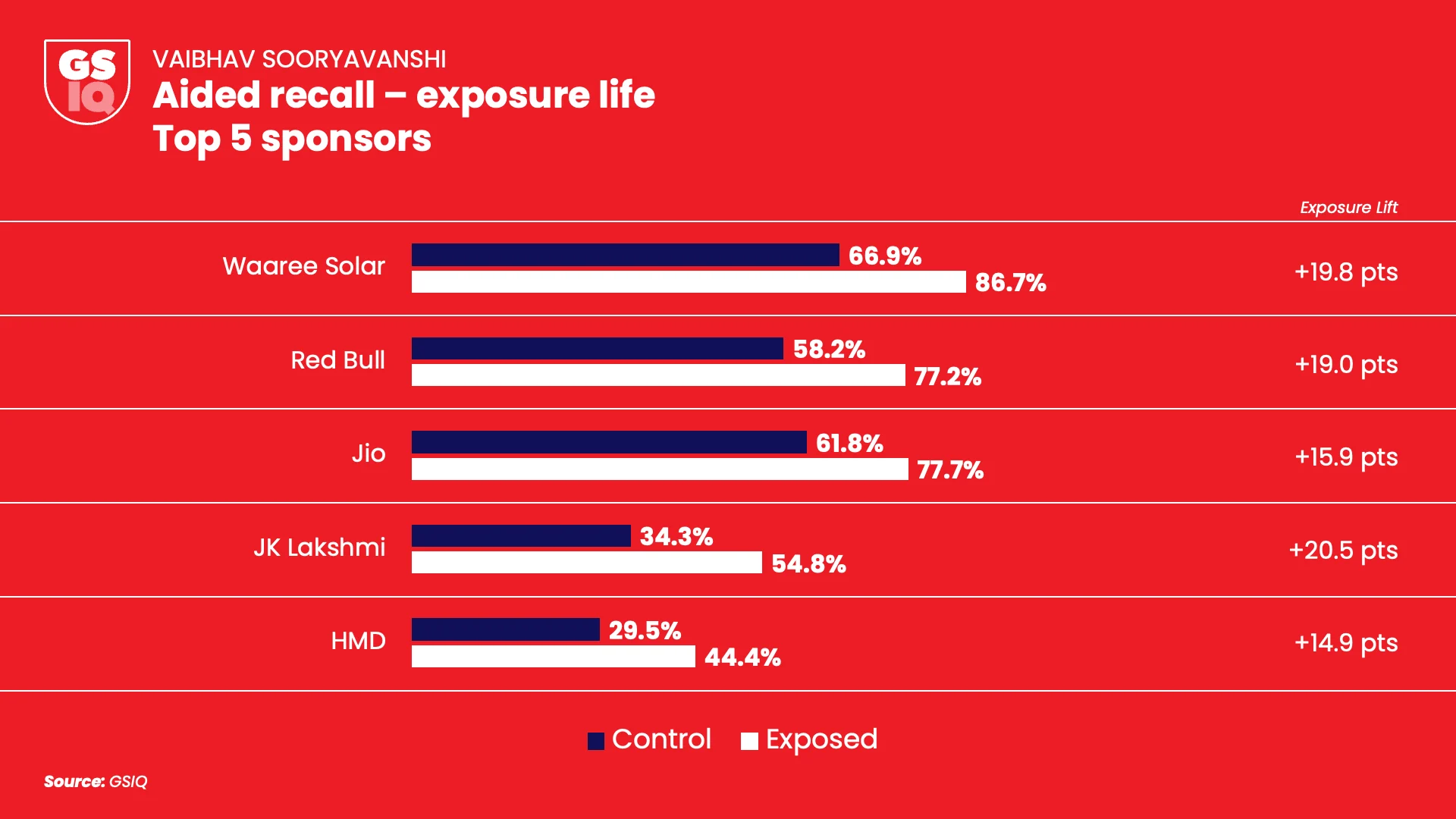
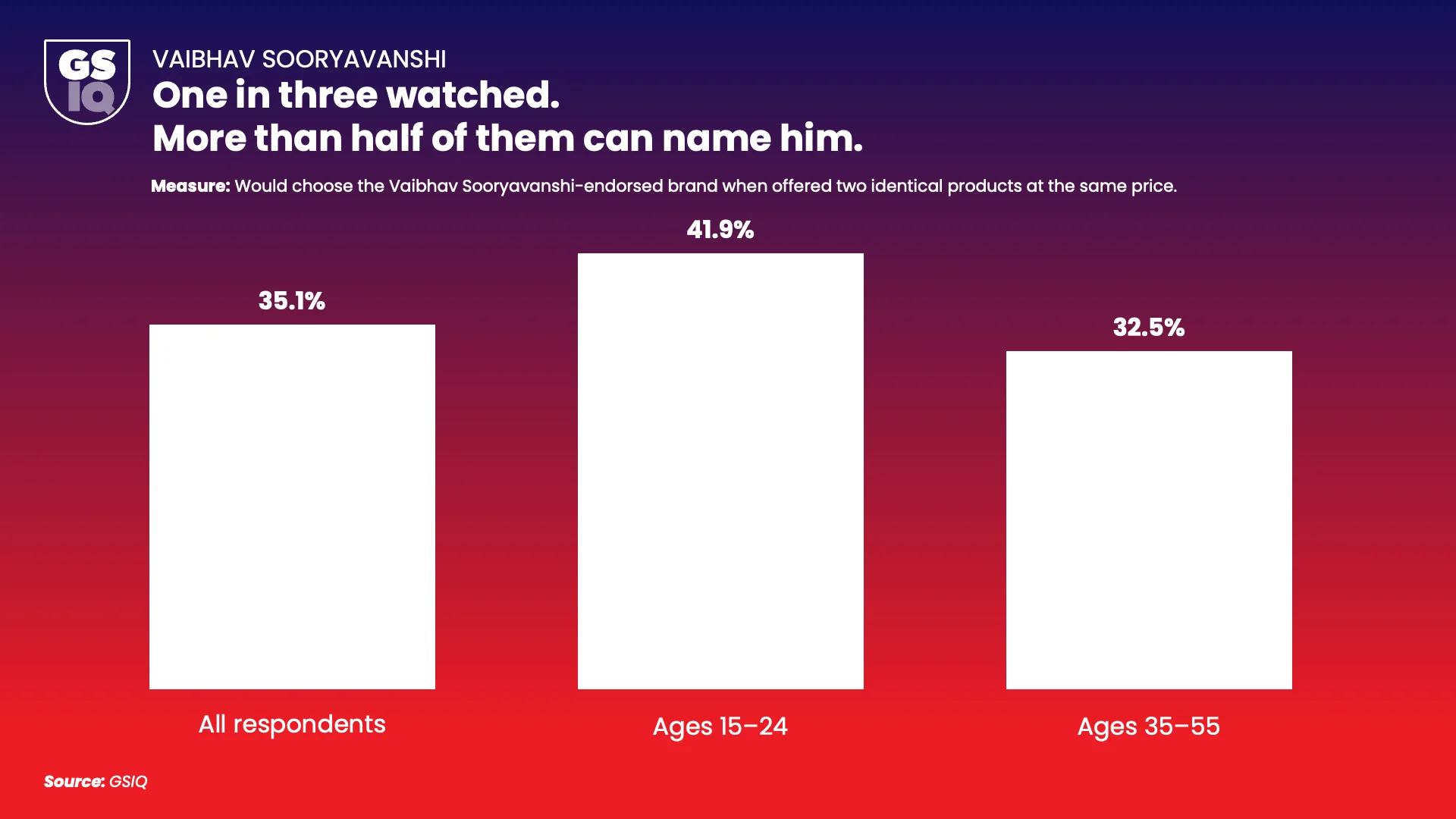
The market is more careful than the noise around it
That is where the commercial read ends and something more interesting starts. We asked about the Tendulkar comparison directly, because everyone else has. Only 9.7% say he is already at that level. 45.8% say he has the potential but needs time, 28.6% say it is simply too early to ask, and 12.3% think the comparison is unfair pressure on a teenager. Just 3.7% say he won’t get there.
Read that distribution as a whole and the Indian cricket public is considerably more disciplined than the discourse. It is optimistic, and it is asking to be allowed to wait.
Three years out
Over a three-year horizon, 33.4% expect him to be a regular in India’s T20 side and 22.3% expect him across all formats. 18.9% see a leading IPL player who doesn’t quite make the national side, and 18.1% won’t call it either way. Only 7.2% – one in fourteen – think the hype fades.
He is early in his innings, and his audience appears to know it.
The wider point isn’t about one player. It is that “he moves the needle” is now a claim you can put a number against – in viewership, in fandom conversion, in advocacy and in what your viewers recall. If you want to know what a single name is contributing to your audience and your sponsors’ outcomes, we can measure it. Get in touch.
Explore GSIQ India & Subcontinent Insights
From cricket to kabaddi, esports to entertainment, GSIQ supports rightsholders and brands across India & Subcontinent with the insight to make bold ideas work.
We’re embedded in the market, and our intelligence is built for its pace, scale and ambition.View our dedicated page for the latest developments in sport, sponsorship, and data intelligence across the region.

WHITE PAPER · AVAILABLE TO DOWNLOAD
NEXT GENERATION OF SPORTS FANS
We asked 5,000 young people across 11 markets one big question: what will it take to make you a sports fan?
Young Indians are more likely to say they are motivated to follow a sport because of a star than any other market we polled – and least likely to be motivated by a local team. Find out more about how to engage this audience using the data in our new white paper.
