


The FIFA World Cup travel data that every travel organisation needs right now
The FIFA World Cup is now fewer than 100 days away. The teams have booked their travel and accommodation and some will enjoy unexpected extensions.
But what about the fans? How long will they stay? Where will they go and what will they be looking for when they get there? How much money do they plan to spend?
Our consumer travel tracker TACTIQ has the answers.
Focusing on a few key markets, we asked travelers intending to visit the World Cup, co-hosted by USA, Canada and Mexico this summer, about their plans for their trip – specifically to the U.S.
The consumers we asked were drawn from Brazil, Colombia, France, Germany, Italy, Spain and UK. In March, this research expands to include Mexico and Canada.
These are all major football markets and, with the exception of Italy who are yet to qualify, they are all sending teams to the tournament (in the case of the UK, potentially three separate teams – Scotland, Wales and England).
Taken together, GSIQ data suggests FIFA World Cup travelers are not simply event attendees but a particularly valuable travel segment, combining higher planned spend with longer stays and broader leisure ambitions. For US destinations and travel brands this represents a value opportunity.

How much will travelers to the US for the FIFA World Cup spend?
GSIQ research shows that planned spend among WC26 US intenders is markedly higher than spend among recent US visitors because a FIFA World Cup trip is not a normal holiday. It is a rare, high-emotion, event-led trip, that involves match tickets, premium event-period pricing, longer stays, multi-city travel and additional leisure spending. March pulse data shows that one in three travelers (29%) are also turning tournament attendance into a broader US holiday, particularly long-haul visitors from Europe, which further increases total trip budgets.
The amount “WC26 US intenders” expect to spend on their World Cup visit is 1.9 times higher than the amount recent visitors to the US spent on their trip – $5,749 vs $2,981.
However, this mean score is pushed up by a small number of very high spenders on long trips for the whole tournament. Median scores, which remove the extreme impact of these higher spenders, are more modest but still much higher than holiday spend by recent visitors. Europeans intend to spend the most, with Brits the highest – 40% of them intend to spend over $6,500.
How long will travelers to the US for the FIFA World Cup stay?
Those intending to come for the World Cup intend to stay much longer than other travelers intend to – 32% of WC26 intenders expect to stay over two weeks compared with only 12% of previous visitors.

Where World Cup intenders want to visit and stay
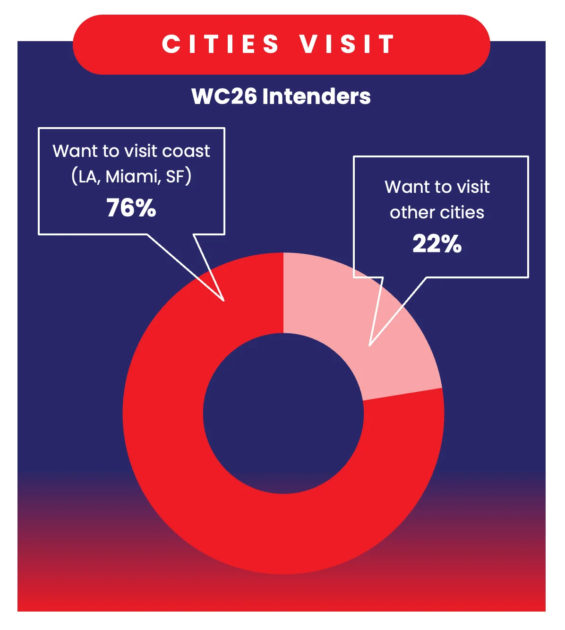 The World Cup is also acting as a catalyst for hybrid trips, with many fans using tournament attendance as the anchor for a wider US holiday. This means the economic upside is likely to reach beyond official host cities, particularly for destinations able to position themselves as part of a multi-stop itinerary.
Before the group stage matches were announced, most intenders were planning to come to the World Cup via the main gateway cities, such as LA, New York and Miami, with San Francisco and Boston a little way behind. There’s a growing momentum for Mexican host cities, particularly Guadalajara, Mexico City and Monterrey, suggesting that fans are increasingly considering broader multi-country itineraries.
Only 2% of WC’26 intenders say they’re unsure which cities they plan to go, indicating that travel plans are mostly defined as the tournament approaches.
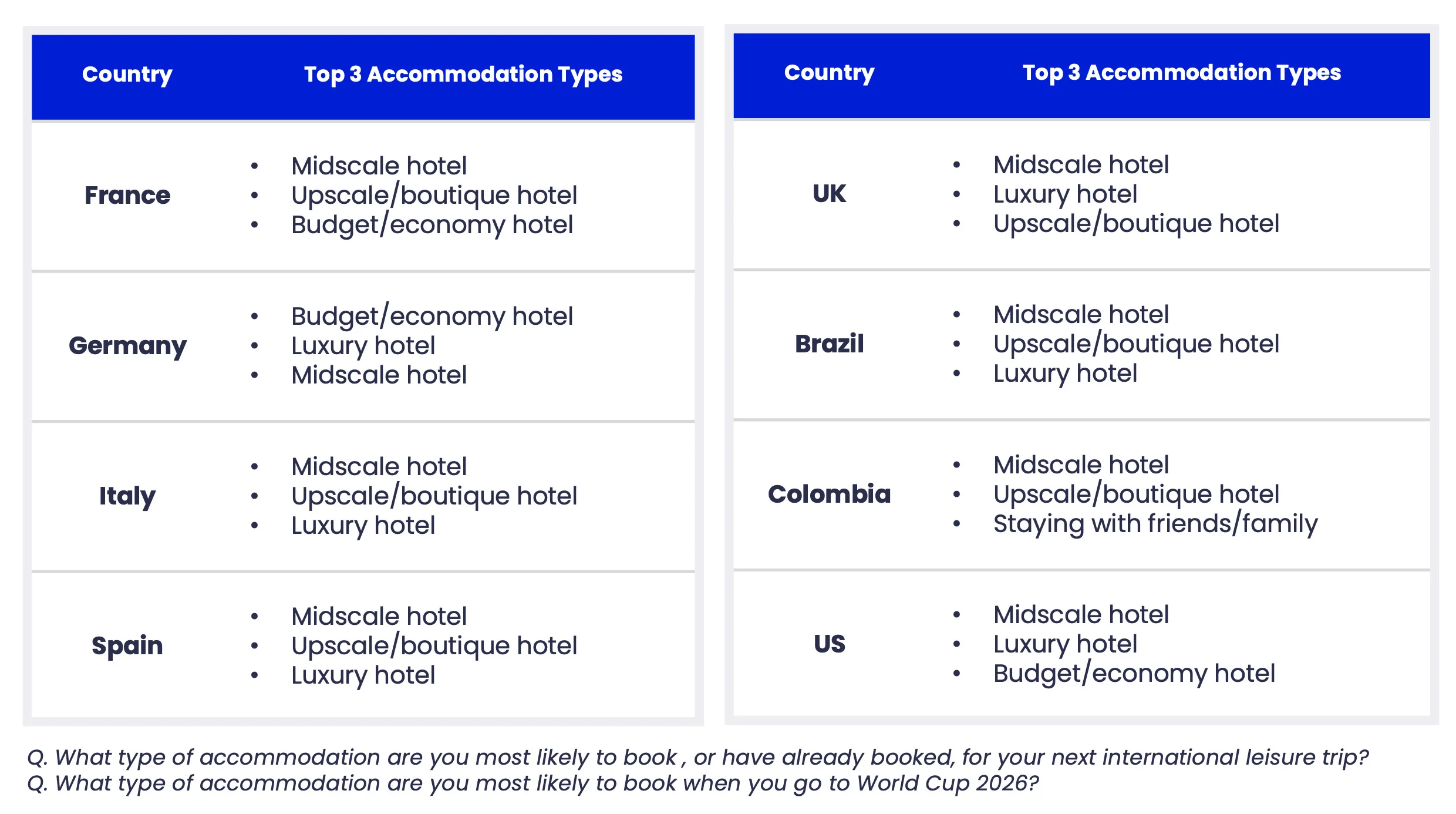
Once they arrive, travelers have clear views on where they want to stay and while there are differences between markets, it’s midscale hotels which top the preferences. Vacation rentals like Airbnb are a preference for just 7% of all intenders, primarily driven by those who intend to travel to the World Cup with a group of friends or their children.
The appeal for luxury hotels is notable among those who intend to travel with a group of other fans (23% vs 8% average) and families.
What are the other activities World Cup Travelers are planning?
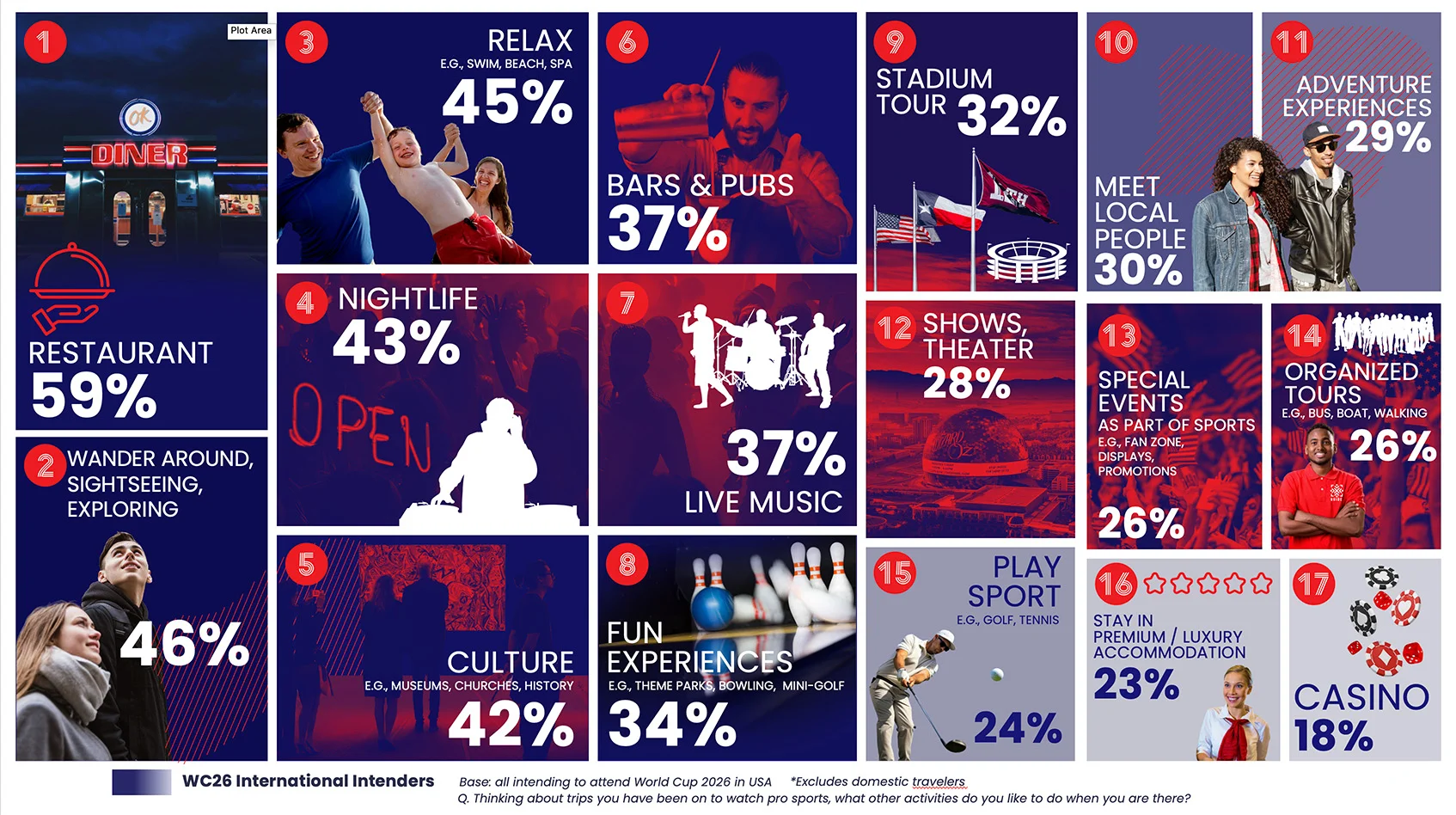
Accommodation and activity choices suggest these visitors are looking for convenience, atmosphere and memorable urban experiences rather than purely football-focused experiences. Dining, nightlife, sightseeing and culture all feature strongly, indicating that the wider destination offer will play an important role in capturing spend.
There are differences between markets (get in touch to find out more) but eating out features heavily on the wishlists of those intending to come to the World Cup. Sightseeing and culture are important but so are pubs, live music and nightlife. Interestingly, playing sport and visiting fanzones are less popular.
For more insight into World Cup travelers, please get in touch.
TACTIQ allows users to discover a range of valuable insights about this audience, including which marketing channels are most effective, the barriers to making trips, the most popular types of purchase journey and the concerns and attitudes of these fans.
GSIQ Tourism Insights – Global Tourism, News, Insights
Explore our dedicated Tourism Insights page and discover how we’re shaping the future of global tourism.


